


It’s here. The juggernaut of all sporting video-games returns for its 25th annual iteration. Yes, folks. FIFA is back, resulting in midnight launches nationwide of tracksuit laden ‘lads’ and a stiff aroma of Energy Drink in the air outside your local video game store.
It’s fair to say that over the years FIFA has become EA’s biggest banker and an easy win when it comes to generating revenue and delivering the premier footballing experience for gamers. However, it hasn’t always been that way. We’re going to take a look back over 25 years of FIFA and pick out the 5 key moments that resulted in it becoming the behemoth of sports gaming that we know it as today.


The importance of the original FIFA cannot be under-estimated. Created almost as a side-project on the back of EA’s genre-defining Madden and Hockey series, FIFA International Soccer was made with extremely low expectations and a relatively tiny budget, even for the early 90’s.
The master-stroke of obtaining a FIFA license instead of creating a generic football title was shrewd, even if it didn’t allow for real player names at the time. The level of sophistication in this game was truly unprecedented, compared to the kings of the genre such as Kick-Off and Sensible Soccer.
The isometric viewpoint added a degree of realism that was missing from your traditional top-down football simulator and we all quickly became attached to those star names borrowed from the game’s real developers, such as Matt Webster, Bruce McMillan and Joey Della-Savia.
It was the little touches, such as crowd reaction, scoreboard presentation and a more simulation style of gameplay, that made it standout amongst its rivals. FIFA International Soccer was the archetype for EA’s high gloss presentation style for many years to come; and whilst it was released on many formats, it was the Mega Drive original that will remain most fondly remembered.


Heavily borrowing from the high presentation values of the earlier 3DO version of FIFA International Soccer, and utilising EA’s Virtual Stadium technology, FIFA 96 was a massive leap forward in the graphical quality and overall polish of the series. Gone were the restrictions of the 2D isometric environment; players could finally choose their own camera angles and the realism of the game was ramped up enormously due to the enhanced stadium effects, audio commentary and real player names for the first time.
The series continued on the 16-bit consoles in its traditional 2D isometric vain for several more years. However, FIFA 96 was the first in the series to transition to a full 3D environment via the new next generation consoles (Sony PlayStation and Sega Saturn) and established the blue print for the series for several years.
In what would seem a rather odd move (or perhaps a shameless cash-in), EA released two football games inside of one annual lifecycle, with FIFA: Road to World Cup 98 (the traditional FIFA game of that year) and an iteration purely focused on the World Cup of that year itself.
It goes without saying that this would be DLC in today’s market, but the fact that the FIFA franchise had grown sufficiently to warrant licensing a World Cup brand was truly remarkable. Hardened FIFA fans will likely re-call Road to World Cup 98 as the best FIFA of the fifth console generation, by introducing the iconic ‘Indoor Mode’, having licensed songs on the soundtrack (who can forget that intro using Blur’s ‘Song 2’?) and graphically it really began to progress with some individual player models and textures.
World Cup 98 was almost identical to RTWC but with some minor refinements, such as focusing the structure of the game and presentation entirely around the World Cup of that year. Whilst people would likely shun a full-price game with such minor improvements nowadays, it was a massive leap forward for the franchise’s positioning as the definitive video game football series and arguably the first step towards FIFA becoming the AAA series we are familiar with today.
READ PAGE 2 TO FIND OUT HOW THE SERIES CONTINUED TO ADAPT

The 10 years between World Cup 98 and Euro 2008 were the darkest in FIFA’s history. Whilst it was debatable in the late 90’s whether EA’s FIFA or Konami’s International SuperStar Soccer series was the pinnacle of the genre, there was simply no contest by the time that Konami had ‘evolved’ their ISS series into PES, with Pro Evolution Soccer 2 in particular starting a long run of incredible football games out of Japan. FIFA simply couldn’t compete and were regularly second best for much of the next 10 years.
That said, the strength of the license and brand loyalty, accrued over several years of top-notch innovative and progressive football games, saw the FIFA games still sell remarkably well over this period, despite being clearly the inferior game. Alas, FIFA returned to form in the guise of a UEFA title when they took on the license for the 2008 European Championships for the first time.
Yes, the strong licensing and heavy emphasis on presentation can go a long way in making the more authentic football experience, which was the one thing that Pro Evolution Soccer had always lacked. Euro 2008 harkened back to the high water period set in 1998. It was easily the best looking, and had world class commentary, full licensed tournaments, music, player names and kits… but most importantly, it just played fantastically well, refining some good progress made in FIFA 08.
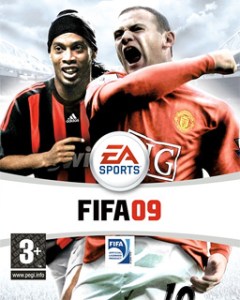
That’s where FIFA 09 comes in to play just a few months later. We’re now talking a whole new level of game. EA had clearly seen the progress made by Konami’s PES and were fearful that its cash-cow would slowly lose market share. EA turned it up several notches for 09 by introducing some incredible new features.


The most namely of these new features were Adidas Live Season, a dynamic player stats system based on the player’s real-life form, and the now all-conquering FIFA ‘Ultimate Team’.
FUT’s beginnings were humble. It was a paid for DLC add-on in its first year, so was a little used feature in its infancy. However, this particular writer took to it immediately and has exclusively played on this mode in FIFA ever since.
Ultimate Team combined aspects of the classic management sim, Topp-Trumps and Fantasy Football League, and fused them together to create the biggest money-spinning game mode in all of console gaming several years down the line. It’s not a stretch to say FUT has outgrown the rest of FIFA and at some point may even become its own monster. It is very much the present and entirely the future of the franchise. But there is still at least one other mode that could challenge in years to come…


As FUT becomes increasing competitive thanks to the introduction of the FUT Champions/Weekend League, and it becoming a budding e-Sport, EA desperately needed a new way to appeal to the casual/less competitive player. Career modes have been popular in FIFA for a while, but the inclusion of storymode ‘The Journey’ in FIFA 17 is the most innovative and exciting feature since the conception of Ultimate Team.
‘The Journey’ sees the player take control of young footballing upstart Alex Hunter, both on and off the pitch. The player controls Hunter in gameplay, but also in a story driven narrative mode by choosing his decisions that ultimately affect the outcome of the first year of Hunter’s career as a professional.
It’s well written, beautifully animated and combines well with Premier League licensing to make an immersive and enjoyable mode. It’s fair to say that the first instance of The Journey is far from perfect, but it’s a promising first step in what is very much the future of the FIFA franchise and what will no doubt be a major component of the forthcoming FIFA 18.
What are your most important moments in FIFA? Agree or disagree with ours? We’d love to hear your thoughts in the comments!