


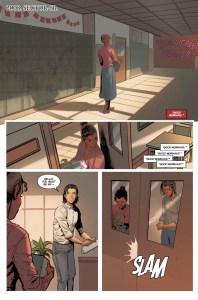
Issue #10 opens with a flashback to Summer 2008. The school district in Sector 6B has welcomed Nexus 4 Replicants through the door as teachers in the community. Nia – introduced to us as a 5th-grade teacher – is enlisted to help them with their training before the start of the school year. But she knows exactly what this project entails. Like in I, Robot, the social change starts at ground level, where the desire for faster, cheaper, and easier automation affects the current infrastructure. Job losses are imminent, and Nia is not afraid of instigating that argument to the recruits about their lack of humanity.
READ MORE: Star Trek: Discovery – Adventures In The 32nd Century #1 – Comic Review

You feel the familiar echoes of Malcolm X when he says, “the most disrespected person in America is the Black woman”. Blade Runner has never shied away from its Dystopian roots, underpinned by a social pyramid system, and Perkins and Brown reinforce it where Blackness is at its core. Nia understands the detrimental effects of the Tyrell Corporation – their privilege and class keep the elite ticking along and the poor in a perpetual state of disadvantage. Yet it falls on deaf ears when her existence is not valued. In the eyes of Llora Stahl, Dr. Kine and Effie, she’s a potential asset to be used and commodified to get a community on board with Tyrell’s technological program.
READ MORE: Wolf Alice – Gig Review
Even if it had good intentions, it naturally follows from my posed commentary in issue #7, how Black bodies are used to propagate institutional agendas by tapping into real-life Black fears of experimentation and the advancement of the modern age. Origins continues to lean into those ethical and moral boundaries by saying this perception hasn’t changed, even when history is abundant with such clear-cut examples. Even if characters display reservations about the programme’s efficacy, the gall of Dr Kine to ask for Effie’s help to convince Nia to participate only illustrates her own complicit bias in asking a Black woman to get another Black woman onside. Effie’s natural response says it all. Nia’s discontent towards a young Llora Stahl even more so.
READ MORE: The Last Journey – Film Review
A brief respite is found in Cal and his rekindled affinity for Desiree. It’s nice to see a different side to him and his protective arc. One wonders what’s next for his character, considering the comic’s notable shift towards its newfound revelations. At one point, Cal suggests to Desiree they escape together – an understandable motion for Black trauma and the protective measures we put in place to survive tragic injustices. But even such a notion is a pipedream when an inescapable war still rages on.
It serves as a foundation for issue 10’s ultimate point – every action has a reaction, and the next edition can’t come soon enough. The series has earned trust and deepened resonance, highlighting how instrumental this story has been to the Blade Runner mythology, and its continued investment is a well-deserved accolade.
Blade Runner Origins #10 is out now from Titan Comics.


